Shopify vs WooCommerce: Which eCommerce Platform Is Right for Your Business?
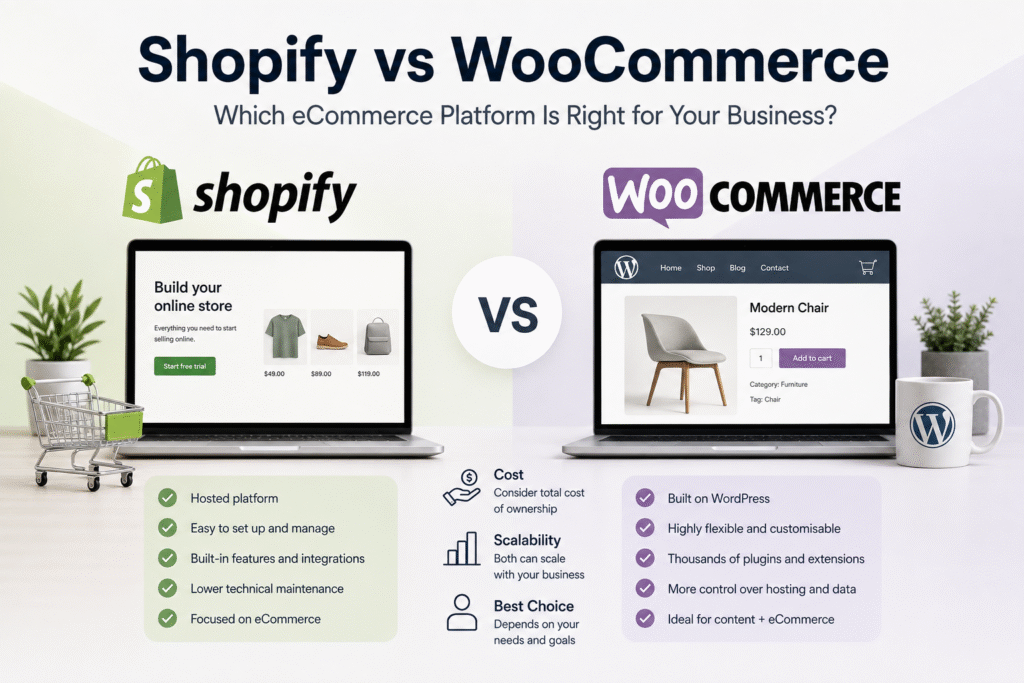
Choosing the right eCommerce platform is an important decision when starting a new online store or rebuilding an existing one.
Two platforms that are frequently considered are Shopify and WooCommerce.
Both can support successful online stores, but they take different approaches.
Shopify is a hosted eCommerce platform that provides many of the tools needed to run an online store within one managed environment.
WooCommerce is an eCommerce plugin for WordPress, giving businesses greater control over their website, hosting, and technology setup.
So, which one is better?
There isn’t a single answer. The right choice depends on your products, technical requirements, budget, desired level of control, and long-term plans.
Let’s look at the main differences.
1. Ease of Use
Shopify is generally straightforward to set up. Hosting, security, and much of the underlying infrastructure are managed as part of the platform.
This can be useful for businesses that want to focus on their products, customers, and marketing rather than managing website infrastructure.
WooCommerce operates within WordPress, which means there are more elements to configure and maintain. For businesses already familiar with WordPress, this may be relatively straightforward. For beginners, there can be a steeper learning curve.
If simplicity and a managed environment are priorities, Shopify may be the more convenient option.
2. Flexibility and Control
WooCommerce gives businesses significant control because it operates within WordPress.
Businesses can customise themes, plugins, hosting, functionality, and other parts of the website.
Shopify also offers extensive customisation through themes, apps, APIs, integrations, and custom development, but it operates within Shopify’s platform and ecosystem.
This creates an important difference:
WooCommerce generally gives you more direct control, while Shopify provides a more managed environment.
The better choice depends on how much control your business actually needs.
3. Website Maintenance
With Shopify, much of the underlying infrastructure is managed by Shopify.
Businesses still need to maintain their content, theme, apps, integrations, and store configuration, but they don’t have to manage the same level of hosting infrastructure.
WooCommerce requires more responsibility for the WordPress environment.
Depending on the setup, this may include:
- Hosting
- WordPress updates
- Plugin updates
- Theme maintenance
- Backups
- Security
- Performance optimisation
That additional control can be valuable, but it also comes with additional responsibility.
For businesses looking to minimise infrastructure management, Shopify may be simpler to maintain.
4. eCommerce Features
Both platforms support the core functionality required for an online store, including:
- Product management
- Shopping carts
- Payments
- Discounts
- Order management
- Customer accounts
- Shipping options
- Analytics
The difference is often in how these features are implemented and extended.
Shopify provides a centralised eCommerce environment with a large ecosystem of apps and integrations.
WooCommerce uses the broader WordPress ecosystem, where plugins and extensions can be used to add functionality.
Rather than comparing the number of available features, it’s more useful to ask:
Does the platform provide the functionality your business actually needs?
5. Customisation
Both platforms can be customised significantly.
Shopify supports theme customisation, apps, APIs, integrations, and custom development.
WooCommerce benefits from the flexibility of WordPress, allowing businesses to customise many aspects of the website and underlying technology.
However, greater flexibility can also mean greater technical responsibility.
A highly customised WooCommerce store may require more ongoing management. Likewise, a complex Shopify store may require development expertise when implementing advanced functionality.
More flexibility isn’t automatically better if you don’t need it.
6. Cost
Cost is an important consideration, but comparing the two platforms based only on their basic pricing isn’t enough.
With Shopify, businesses may need to consider the platform subscription, apps, themes, development, and other services.
WooCommerce itself is open source, but businesses still need to consider hosting, domain registration, themes, plugins, development, security, maintenance, and other costs.
The actual cost can vary significantly depending on how the store is built and what functionality it requires.
It’s therefore better to consider the total cost of running and maintaining the store, rather than simply looking at the initial price.
The cheapest option at the beginning isn’t necessarily the most cost-effective option over time.
7. Scalability
Both Shopify and WooCommerce can support growing online businesses.
Shopify provides managed infrastructure and tools designed for businesses at different stages of growth.
WooCommerce can also support large and complex stores, but scaling may require careful management of hosting, databases, plugins, caching, security, and overall performance.
Scalability isn’t simply about how many products a platform can handle.
It’s also about whether the platform can support your business as its requirements become more complex.
Shopify or WooCommerce: Which Should You Choose?
Shopify may be a good fit if you want:
- A managed eCommerce platform
- A simpler setup
- Less responsibility for infrastructure
- A large ecosystem of apps and integrations
- A platform focused specifically on online commerce
WooCommerce may be a good fit if you want:
- Greater control over your website
- The flexibility of WordPress
- Extensive content management capabilities
- More control over hosting and infrastructure
- A highly customised WordPress-based store
Neither platform is automatically better.
The right choice depends on what you’re trying to build and how you want to manage it.
What If You Already Have a WordPress Website?
If your business already uses WordPress, WooCommerce may seem like the obvious choice.
And in many cases, it can be.
However, it’s worth considering whether your existing website and technical setup are suitable for the eCommerce functionality you plan to introduce.
If selling products becomes the primary purpose of the website, Shopify may provide a more focused eCommerce environment.
The decision should be based on business requirements rather than simply choosing the technology you’re already familiar with.
Final Thoughts
Shopify and WooCommerce are both capable eCommerce platforms, but they approach online selling differently.
Shopify provides a managed environment with eCommerce functionality built into the platform.
WooCommerce provides the flexibility of WordPress and gives businesses greater control over their website and technology stack.
Before choosing between them, think beyond the initial setup.
Consider:
What does the business need today?
What might it need in the future?
How much technical control is actually required?
How much ongoing maintenance can the team manage?
What is the total cost of running the store?
The best eCommerce platform isn’t necessarily the one with the most features.
It’s the one that fits the business, its customers, and its long-term goals.
